Home About us
Products
News
Solution
Video Service Contact us
Home  /  News

In the aggregate and mining industries, both Impact Crushers and Hammer Crushers are popular choices for processing medium-hard materials like limestone. However, they are not interchangeable. Understanding their internal differences is key to maximizing your profit. Here is a breakdown of the three main differences:


1. Internal Structure & Working Principle

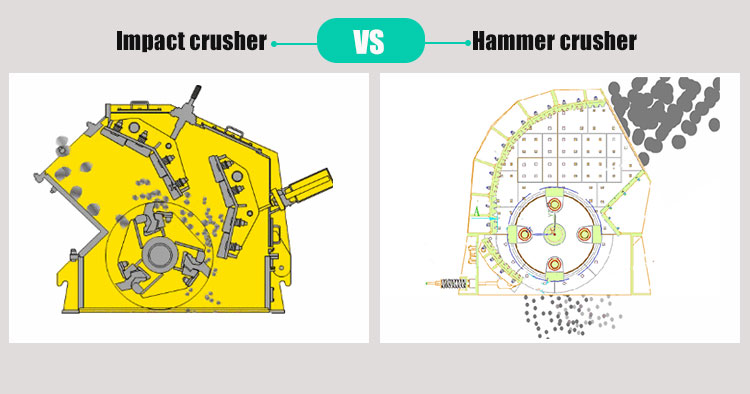
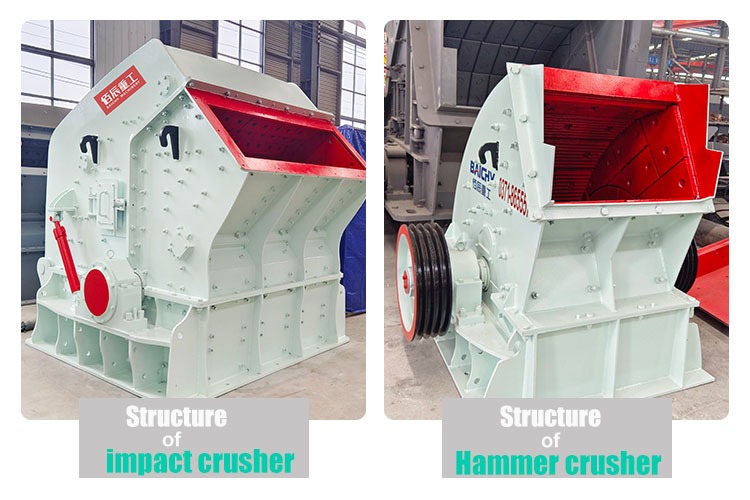
Impact Crusher: It features a rotor with fixed blow bars (plate hammers). The rock is thrown against impact curtains (aprons) and bounces back to the rotor. It relies on high-speed impact force and has a large, open crushing cavity.
● Hammer Crusher: It uses a rotor with swinging hammers. The hammers crush the material against a grate (screen plate) at the bottom. The material stays inside the chamber until it is small enough to pass through the grate openings.
 

Impact crusher VS hammer crusher1


2. Output Product Shape (Quality)

Impact Crusher: The "impact" force breaks rock along natural cleavage lines, producing a cubical shape with very low flakiness. This makes it the top choice for high-grade highway asphalt and concrete aggregate.
● Hammer Crusher: Because the rock is ground against the grate, it produces more powder and fines. The particle shape is generally good but can be inferior to the impact crusher. It is better suited for industrial applications (cement, coal) where shape is less critical than size.


3. Applications & Limitations

Impact Crusher: Best for medium-hard rock (limestone, construction waste). It handles moisture well because it has no bottom grate to clog.
● Hammer Crusher: Best for soft to medium-soft materials (coal, gypsum, chalk). Warning: If the material is wet or sticky (clay), the bottom grate will clog immediately, halting production.

 
Impact crusher VS hammer crusher2
 
If your project requires high-quality cubical aggregate for construction, choose the Impact Crusher. If you need a high reduction ratio for soft material like coal or cement production and don't mind higher powder content, the Hammer Crusher is a cost-effective solution. Baichy Machinery has a history of more than 20 years. It not only produces a full set of crushing and sand making equipment, but also provides EPC project general contracting services, including plant site selection and construction, production line design and installation, and production and operation technical training. Welcome to consult online to get your exclusive stone crushing plant solution.


People Also Frequently Asked Question-FAQ:

1. Is a hammer mill an impact crusher? 

A hammermill is one of several types of crushing machines, including impact crushers, jaw crushers, and cone crushers, that is manufactured for the purpose of processing raw materials to reduce them in size. It is different from impact crusher due to the hammer sturcture.
 

2. What is a impact crusher?

 An impact crusher is a machine that uses striking as opposed to pressure to reduce the size of a material. Impact crushers are designated as a primary, secondary, tertiary or quarternary rotor crusher depending on which processing stage the equipment is being utilized.
 

3. What are the different types of impact crushers?

 Impact crushers are traditionally classified into two main types, horizontal shaft impact (HSI) crushers and vertical shaft impact (VSI) crushers.
 

4. How do I choose a crusher?

Important specifications and features when selecting industrial crushers include:

  - Feed size, material, and hardness must be considered.

  - Output size ranges.

  - Crushers accept dry or wet input, or both.

  - Crushers are feed in batches or continuously.

  - Capacity requirement

 
Maybe you are interested in